

 Español de México
  English
  繁體中文
繁體中文  Français
  Português do Brasil

Your cattle weigh scales worked fine last season. Then one morning, it shows a reading that makes no sense. You re-zero it. Still wrong. You call a repair service. The quote hits hard. And the worst part? The scale was giving bad readings for weeks, and you didn’t know.
The hidden costs of inaccurate livestock scales go beyond wrong readings. The right cattle weighing scales save you, while Inaccurate cattle weighing scales quietly hurt your farm. You feed animals based on wrong numbers. You stop trusting your own data.
The fix is not hard. But you do need to stay consistent. This guide will show you how to keep your cattle scales running longer and more accurately without surprise breakdowns.
Índice
ToggleThe livestock scales cattle operations rely on take daily usage. Most farm scales don’t break because they’re cheap. The area near the squeeze chute stresses the corner load cells the most. Life around livestock is tough on equipment. Manure, mud, water, and heavy daily use all add up.
The biggest threat is organic acid corrosion from manure. It eats through the steel platform, the load bars, and the cable glands underneath. Most farmers only see the damage after it gets expensive.
Before you can protect your scale, you need to know what’s inside it.
The load cell is also called a load bar on some models. It turns weight into an electrical signal. Most cattle scale platforms have four of them, one in each corner. If one fails, your readings go wrong or stop making sense.
Load cells get damaged by:
The digital indicator is the screen that shows the weight. The junction box links all four load cells to that screen. Both parts need to stay dry and clean to work properly. If your scale won’t go back to zero between animals, a dirty or wet junction box is one of the top causes of zero-balance drift.
Never point a pressure washer at your load cells or junction box. The water force pushes moisture into sealed parts that can’t handle it. Start livestock scale troubleshooting with cables and connections.
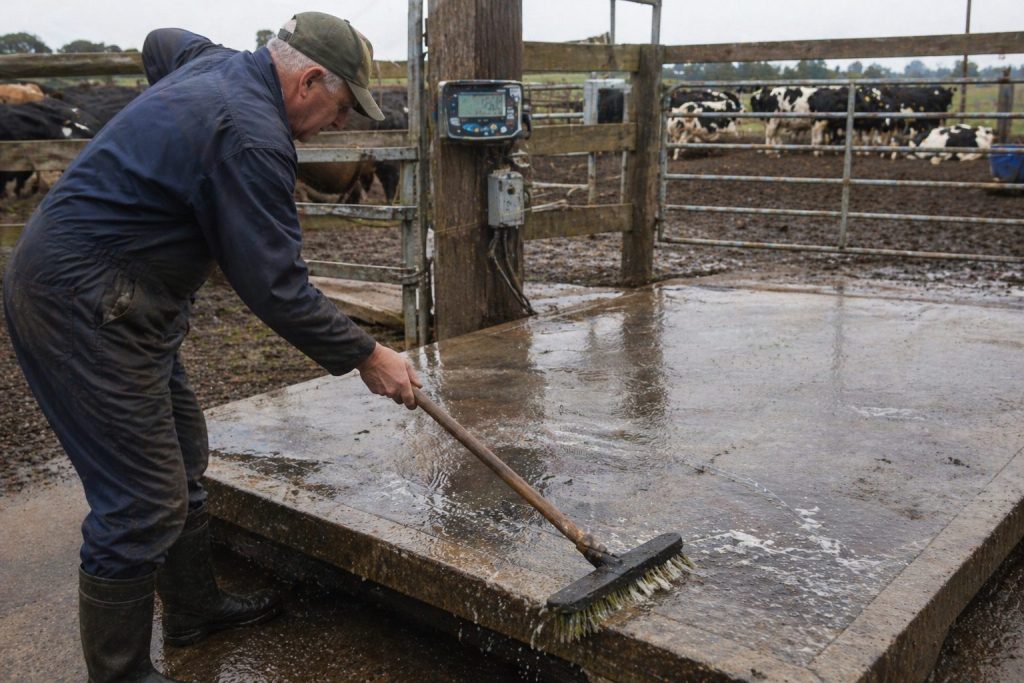
Use a soft brush and a mild, pH-neutral cleaner instead. Wipe the steel platform and the area underneath after every heavy use. Pay close attention to the area around the weigh beams and cable entry points.
Calibration means checking your scale with known traceable test weights to make sure it reads correctly. Check for cable damage every time you calibrate. This keeps cattle scale calibration costs low.
Wondering how often you should calibrate a portable livestock scale? Do it at least twice a year. Also, recalibrate after moving the scale, after a hard animal hit, or after any repair work.
Multi-point calibration is the best way to do it. You test the scale at several different weights, not just one. This finds problems across the full weight range. If you’re not sure how to do it yourself, search for farm scale calibration near me and call a certified technician.
Rust is easy to spot. Moisture damage inside the scale is not. The best way to protect livestock scale load cells from moisture is with tight seals and closed lids.
Check your anti-slip coverings often. When they wear out, bare metal is exposed and rusts fast. Replace them before the platform structure underneath gets damaged.
For the inside parts, good sealing is your best defense. Make sure all cable glands are tight. Check that the junction box lid closes with no gaps. If you use portable livestock scales outside or in wet areas, put a weatherproof cover on when the scale is not in use.
The farmers who get the most life from their animal scales treat maintenance as a regular job, not something they do after something breaks. A simple computerized maintenance management system (CMMS) helps a lot. Even a phone calendar with reminders works fine.
| Task | Frequency | Who Does It |
| Remove manure and debris from the platform | Diario | Farm staff |
| Wipe load cell housings and cable glands | Weekly | Farm staff |
| Inspect the junction box for moisture or corrosion | Mensualmente | Farm staff |
| Check anti-slip platform coverings for wear | Mensualmente | Farm staff |
| Multi-point calibration with traceable test weights | Twice yearly | Technician or staff |
| Full professional livestock scale maintenance service | Annually | Certified technician |
| Full inspection after any impact, move, or repair | As needed | Certified technician |
Write down every cleaning, calibration, and check. If something feels off, either it’s a strange reading or a wobbly platform. You have to write it in the log right away. Patterns in your notes help you catch problems early.
Not every livestock weighing scale is worth fixing. Early repairs beat a full cattle scale load cell replacement. If your unit has badly corroded load cells, a cracked platform, and a failing indicator, major repairs may not make sense.
Look for the best cattle scale with sealed entries and a rated junction box. Before you move forward, keep this in mind:
Choose equipment that fits your farm conditions and not just your short-term budget.
Cattle weighing scales are working tools. They are not set-and-forget equipment. Farms that get long life from their livestock scales clean them often, calibrate on time, and fix small issues early.
Check your load cells and cable glands for rust or moisture. Plan a calibration with test weights or call a technician. Keep a simple maintenance log on your phone.
If you need a better unit, explore farm equipment and livestock scales made for real farm use. A well-maintained scale stays accurate and reliable for years.
Your load cells or junction box are likely damaged. Moisture and corrosion cause random signal errors. Calibration won’t fix this; the hardware needs a physical inspection.
Most electronic livestock scales last 8–15 years with good maintenance. Harsh conditions, heavy daily use, and poor drainage shorten that significantly.
A damaged wiring harness, failing load cell, or loose junction box connection is usually the cause. Check all connections first, then test each load cell individually.
Yes, if the platform frame and digital indicator are still in good shape. If structural steel is corroded or multiple parts are failing, full replacement makes more sense.
Calibration fixes a scale that reads consistently wrong. If readings are random or drift after zeroing, that’s a hardware failure, get a technician to inspect the components.
Regístrese para recibir actualizaciones, promociones y adelantos de los próximos productos. Además, 20% de descuento en tu próximo pedido.