


Your team is measuring packages with a tape measure. One worker rounds up. Another round down. By Friday, carriers hit you with surprise reweigh fees for packages measured wrong on Monday. You can’t fight the charges because you have no proof.
This is the hidden cost of manual package measurement processes. It bleeds hours, accuracy, and profit every single shift. Automated Dimensioning Systems fix this at the root. They capture exact length, width, and height in under two seconds with a photo log you can show the carrier. Explore full warehouse automation solutions built to end this problem for good.
Table of Contents
ToggleTape measures work fine for 10 packages a day. They fall apart at 500. Workers get tired. Numbers get rounded. Odd-shaped boxes get guessed.
The result is inaccurate package dimensions across your shipping manifest. Carriers catch the errors during their own scan. Then they bill you back for the difference. These adjustments show up weeks later, long after you’ve already quoted your customer.
One wrong measurement triggers five downstream problems. Wrong cartonization. Wrong label. Wrong truck load plan. Wrong invoice. Wrong customer quote next time.
By the end of a quarter, these small errors add up to thousands of mislabeled shipments. That’s the real cost of time-consuming parcel processing done by hand.
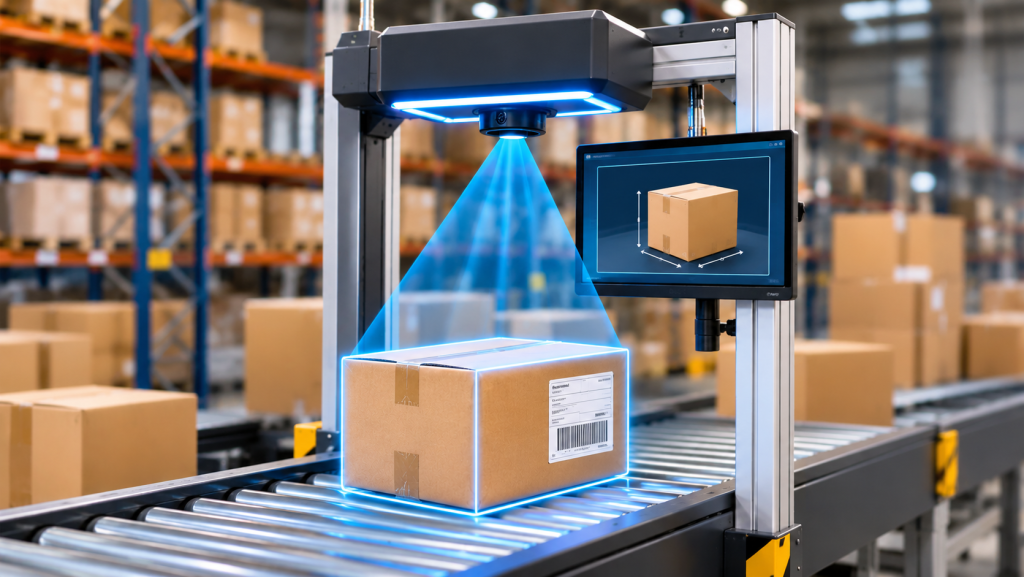
An automated dimensioner uses sensors, lasers, or AI cameras to measure a package instantly. It captures length, width, height, and often weight at the same time. The data flows straight into your WMS or shipping software.
No tape. No clipboard. No typing. Just place the package on the pad or send it down the belt. The system does the rest.
Most systems share three parts working together as automated measuring equipment:
This stack replaces three or four manual steps with one. That’s where the real time savings come from.
The static vs. dynamic dimensioners question trips up most warehouse managers. The right pick depends on your layout and daily volume.
A static dimensioning system sits at a packing station. The worker places the box on the scale pad. The system scans it in about two seconds. Perfect for pack-out stations and lower-volume shippers.
A dynamic dimensioner mounts over a conveyor belt. Packages move under it at full speed. It measures each one on the fly without stopping the line.
| Feature | Static Dimensioner | Dynamic Dimensioner |
| Best for volume | Under 1,000 parcels/day | 1,000+ parcels/day |
| Install location | Packing station | Over conveyor |
| Measurement speed | 1–2 seconds per package | On the move, no stops |
| Worker involvement | Place and scan | Fully hands-free |
| Setup complexity | Plug and play | Requires conveyor integration |
If you’re starting out, static is the lower-risk entry point. If you’re scaling past 1,000 parcels a day, dynamic earns its keep fast.
An AI dimensioning system is not the same as laser systems. An AI dimensioning system uses machine vision to interpret the dimensions of items that laser technology cannot pick up, such as poly mailers, tubes, bundled items, or odd box packing. Based on a 2024 DC Velocity study, companies that employ AI dimensioners have a 40% reduction in dimensional shipment mistakes compared to manual dimensioners.
Why is this accuracy crucial? Carriers have invested in their dimensioners in all hubs. If your figures do not align, they win.
Modern AI dimensioners add layers manual methods can’t match:
These features turn warehouse scanning equipment from a measuring tool into a full proof-and-audit system.
Teams using automated dimensioning report faster and more accurate package measurements across the board. A packer who used to handle 60 parcels an hour can push past 150 with the right station setup.
That’s not just about speed. It also means accurate shipping cost calculations quoted to your customers upfront. No more surprise upcharges. No more apology emails. See how custom warehouse automation builds match these systems to your exact floor layout.
Three things shift immediately after rollout. Pack stations stop waiting on the tape measure. Shipping manifests match carrier records. And supervisors stop fielding “which box goes in which tote” questions all shift.
Every vendor will tell you dimensioners fix everything overnight. The truth is a little more practical. The hardware works great, but only if you set up the space around it correctly.
Reflective shrink wrap and jet-black poly bags can confuse older laser sensors. The fix is simple: choose an AI-based system trained on those materials. On conveyors, keep a 2-inch gap between packages so the scanner reads each one cleanly. And if your ceiling is low, a static station at pack-out skips the overhead mount entirely.
Software is where most teams hit a wall. If your WMS is custom-coded or runs on older infrastructure, plan for a few weeks of API work before data flows smoothly. That’s not a flaw in the dimensioner. It’s a normal part of connecting any new tool to a legacy system.
The BA-DS2424 ShipStation-version automated shipping integration was built with these exact hurdles in mind. It ships pre-configured for common WMS platforms so your team isn’t stuck waiting on custom code.
The bottom line: dimensioners deliver exactly what they promise when the workflow around them is clean. Measure your space, check your software compatibility, and pick the right form factor. The rest takes care of itself.
Automated dimensioning turns one of the slowest, most error-prone warehouse jobs into a two-second step. That’s the main gain. Everything else—fewer disputes, better cube planning, faster pack rates—flows from that single fix.
Start by auditing your current measurement workflow for one full day. Count how many packages get measured, how long each one takes, and how often numbers get re-keyed. That baseline tells you which system fits.
Next, pick static or dynamic based on volume, not hype. Then plan your WMS integration before the hardware shows up. Browse purpose-built warehouse automation equipment and quality software to match the right tool to your flow.
Use an automated dimensioner at your pack station. It captures length, width, and height in under two seconds with a photo log. That photo is your proof when a carrier tries to re-bill you for a package they claim is bigger than what you recorded.
Replace the tape measure with a static or dynamic dimensioner. A static unit at each pack station cuts measurement time from 30 seconds to about 2 seconds per box. A dynamic unit over your conveyor removes the step entirely—packages get measured while they’re already moving.
Yes, significantly. Manual measuring introduces human rounding, fatigue, and inconsistency across shifts. AI dimensioners read the same package the same way every time, within 0.2 inches. In real warehouse rollouts, that consistency cuts carrier reweigh disputes by roughly 40%.
It removes the slowest step in your pack-out process. Packers stop reaching for tape measures, stop typing numbers into spreadsheets, and stop arguing about box sizes. That freed-up time pushes throughput from around 60 parcels per hour to 150 or more at a well-run station.
A dynamic dimensioner mounted over your main conveyor line. It handles 1,000+ parcels per day without slowing the belt. Pair it with an AI vision head so it reads poly bags and odd shapes, not just clean boxes. Static units work fine at individual stations but can’t keep up with full-line speed.

Sign up to receive updates, promotions, and sneak peaks of upcoming products. Plus 20% off your next order.