


Your warehouse team wasted two hours wrapping pallets yesterday. That’s time lost on shipping, picking, and moving products. You’re wondering if slow pallet wrapping is creating a packaging bottleneck that costs you real money.
The worst part is you don’t know if you’re using the right pallet wrapping machine. Some warehouses buy expensive automatic equipment they don’t need. Others get stuck with slow semi-automatic machines that create slow dispatch times during busy seasons.
The answer is simple: match the right stretch wrapper machine to how your warehouse actually works. Understanding whether you need a semi-automatic pallet wrapping machine or an automatic stretch wrap machine means the difference between fast operations and constant frustration. Learn more about our industrial equipment solutions.
Table of Contents
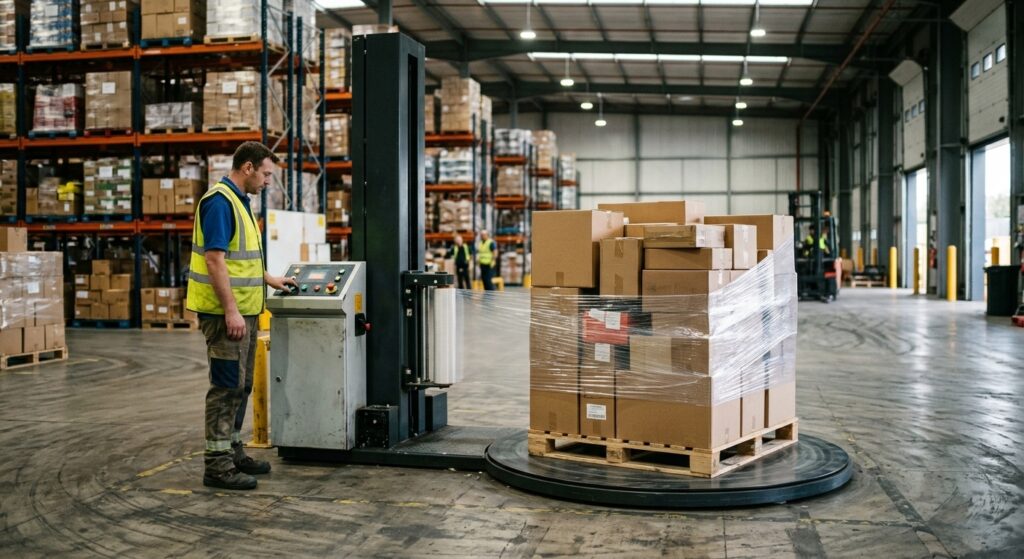
ToggleA semi-automatic stretch wrapper is a helper. It does most of the work. Your worker puts the pallet on and pushes buttons. They control the speed.
An automatic pallet wrapping machine is like a robot. You put the pallet on, and it wraps everything by itself as a hands-free load wrapping system. No worker touch needed.
Both machines are good, but they serve different needs. Automatic works best when you wrap lots of same-sized pallets for consistent wrapping. Semi-automatic works best when pallets are different sizes or shapes.
Every minute your pallet sits getting wrapped is one minute closer to the shipping deadline. Hand wrapping takes 3–5 minutes per pallet, but it isn’t the fastest way to wrap a pallet. Semi-automatic takes 2 minutes, while a fully automatic stretch wrapper takes 1 minute.
Wrapping 100 pallets daily:
But here’s the catch: these times only work if pallets are ready. Messy or uneven pallets slow everything down.
Not every warehouse needs a fully automatic packaging system.
Semi-automatic gives you control. You trade speed for flexibility.
Fully automatic machines work best for high volume. They wrap every pallet exactly the same: same tightness, same coverage, same quality.
This automatic pallet wrapping consistency fixes three problems:
Here’s what sellers don’t say: automatic machines need perfect pallets. Crooked or badly packed pallets make machines stop working.
Many warehouses accidentally improve packing when they get automatic machines. Better machines force better habits.
| Factor | Semi-Automatic | Fully Automatic |
| Time per pallet | 2 minutes | 1 minute |
| Worker helps? | Yes, a lot | No, just loads |
| Film waste | 15–22% | 8–12% |
| Best for daily volume | 25–75 pallets | 75+ pallets |
| Different pallet sizes? | Yes, easy | No, needs same |
| Training time | 1–2 weeks | 3–4 weeks |
| Hard to fix when broken? | No | Yes |
Workers on semi-automatic machines often use way too much film because inconsistent wrapping makes them think more film means safer pallets. It doesn’t. It just costs money.
Automatic machines use the right amount because they measure everything. Semi-automatic workers can learn this too. Teach proper wrapping technique; one warehouse saved 14% on film just by better training.
Don’t use too little film either. Damaged pallets during shipping cost way more than film savings.
High labour costs eat into profits. If you pay a worker $18 per hour to wrap 40 pallets in 8 hours, that’s $0.75 per pallet in labour ($75 per day, or about $18,750 per year).
Semi-automatic cuts worker cost to $0.25 per pallet. Automatic cuts it to $0.10 per pallet.
You don’t fire the worker; you move them to picking or packing. That’s real money saved because those jobs make the company money.
Automatic machines shine during busy seasons. Instead of hiring extra workers, buy one machine to achieve faster wrapping. The downside: automatic machines can break. Then you can’t wrap anything. With semi-automatic, workers can still wrap by hand if needed.
No machine wraps a bad pallet well. If pallets are crooked or uneven, automatic machines reject them. Semi-automatic workers might force it, but wrapping looks bad.
Before buying any machine, check how you pack pallets. Are boxes stacked straight? Is weight spread evenly? You can also check integrated setups like a pallet wrapping machine with a scale from the Best pallet wrapper suppliers in the USA to streamline weighing and wrapping at once. Check your industrial scales setup to ensure weight distribution is accurate.
Fix packing first. Then buy the machine. When you do, your whole operation improves.
See our stretch wrap machines for different warehouse sizes, or browse our full range of products.
Your slow pallet wrapping probably doesn’t need a faster machine it needs the right machine for your actual warehouse.
Semi-automatic works great with different pallets and tight budgets. Automatic works great with many same-sized pallets. Pick the one matching your real business.
Do these three things this week:
Find all industrial equipment for your warehouse to eliminate your wrapping bottlenecks today.
Pallet wrapping takes a long time due to manual hand wrapping, poor pallet stacking, improper worker training, or using the wrong pallet wrapping machine for your warehouse volume.
Yes, a semi-automatic pallet wrapping machine can handle busy operations wrapping up to 75 pallets daily, especially if you deal with varying load sizes and odd-shaped packages.
You can achieve lower film consumption by using pre-stretch features, training workers on proper overlap techniques, or upgrading to an automatic stretch wrap machine that precise-measures film application.
Yes, machines deliver reduced labour costs. Semi-automatic wrappers lower manual effort significantly, while an automatic stretch wrapper offers hands-free load wrapping, allowing workers to focus on picking and packing.
The pallet wrapping machine price varies by automation level. Semi-automatic units are lower-cost entry options, while the automatic stretch wrapper price is higher upfront but yields greater long-term savings for high-volume operations.

Sign up to receive updates, promotions, and sneak peaks of upcoming products. Plus 20% off your next order.