


Unstable pallets break in transit. Hand wrapping causes loose wrapping, worker injuries, and damaged goods at customer delivery docks. When your crew rushes during peak hours, wrapping consistency drops fast.
A dedicated stretch wrap machine for pallet packaging fixes these dock bottlenecks. It delivers consistent containment force, lowers material usage, and keeps your shipping floor safe. Let’s discuss it in detail.
Table of Contents
ToggleHand wrapping pallets creates hidden problems for growing shipping departments. Workers tire quickly, leading to uneven tension and weak wrap patterns.
When pallets lack proper containment force, freight shifts on delivery trucks. This movement results in crushed cartons and expensive damage claims. Manual handling also consumes excess plastic because workers cannot manually stretch modern machine-grade film.
Hand wrapping only stretches film about 10 to 20 percent, leaving loose layers that fail under pressure. Machine wrapping stretches film 200 to 300 percent, creating rigid, tightly bound loads that hold up during transit.
Selecting the right equipment requires matching machine motion to your daily freight profile.
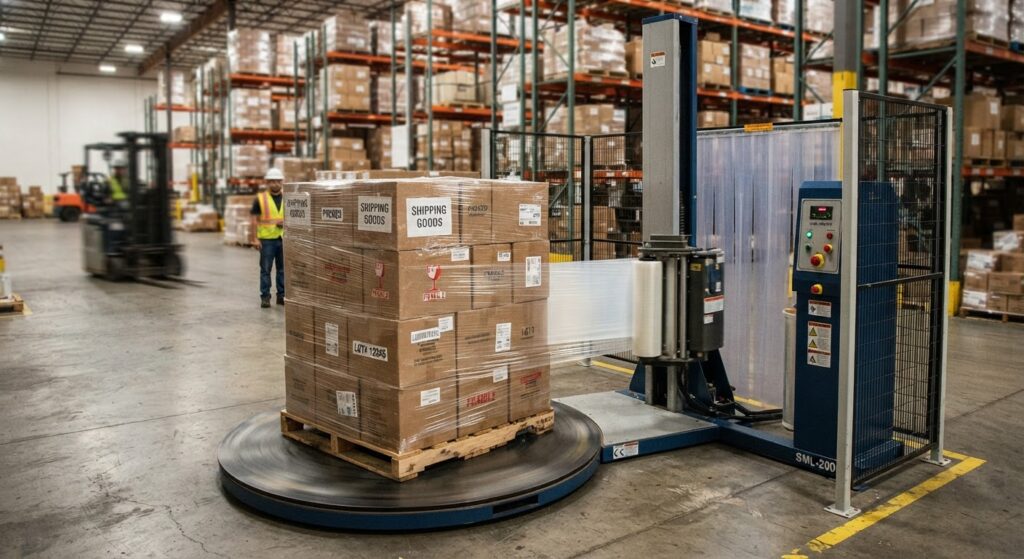
A semi-automatic stretch wrapping machine requires an operator to place the pallet and attach the film.
An industrial pallet wrapper with full automation eliminates manual touch points entirely.
Here’s a quick automation selection tree
| Under 30 Pallets/Hr | Semi-Automatic Turntable Wrapper |
| 30 to 60 Pallets/Hr | High-Speed Automatic Wrapper |
| Over 60 Pallets/Hr | Conveyorized Inline System |
| Fragile / Unstable | Stationary Rotary Arm Wrapper |
Modern pallet wrapping equipment does more than spin film around boxes. Advanced systems continuously adjust tension based on package corners.
A smart packaging machine uses automated load detection to read pallet height and profile changes. Modern units also feature AI-powered pallet wrapping logic to adjust carriage speed on fragile goods. This smart wrapping process prevents crushed corners while locking the freight to the wooden skid.
The packaging research group at Virginia Tech found that machine-applied film with correct prestretch improves pallet load stability by over 40 percent compared to hand wrapping.
Using the right stretch film wrapper dramatically reduces your daily plastic footprint.
A powered film carriage changes how your warehouse uses consumable wrap.
Consistent stretch film application ensures consistent results on every shift. With proper stretch film usage, you achieve significant film savings while gaining faster packaging speeds. Secure loads move out the door faster with less manual work and reliable operation.
Review your floor space, load weights, and speed requirements before purchasing machinery.
A turntable stretch wrapper machine turns the load on a heavy rotating plate. This design works best for solid, uniform freight. For tall, light, or unstable loads, choose an automatic stretch wrapper with a rotary arm. The arm travels around the load while the pallet stays still on the floor.
| Machine Type | Hourly Output | Load Type | Ideal Footprint |
| Semi-Automatic Turntable | 10–30 | Uniform, stable cartons | Compact dock space |
| Rotary Arm Wrapper | 30–60 | Heavy, fragile, or tall | Medium open floor |
| Automatic Conveyorized | 60–100+ | High-volume production | Dedicated packaging line |
| Mobile Robotic Wrapper | 15–25 | Oversized, varied pallets | Flexible open warehouse |
An automatic pallet wrapper is a rugged tool, but it requires proper maintenance. Dust from corrugated boxes settles on photocells, causing height-sensing errors. If operators fail to clean sensors weekly, the carriage can overshoot loads and tear film.
Machine settings must match your wrap gauge. Thin high-performance film will snap on square corners if tension settings are too tight.
When you search for an automatic pallet wrapper for sale, choose an experienced supplier. The specialists at Scale Depot provide full technical guidance on settings, maintenance, and parts support.
A well-chosen pallet wrapper eliminates shipping damage, cuts plastic consumption, and frees warehouse staff for other duties. Matching wrapper mechanics to your daily pallet profile ensures fast payback and reliable dock operations.
First, record the dimensions, weight, and stability of your most fragile load. Next, calculate your peak hourly pallet volume during your busiest shipping window.
Review current equipment specifications and buy pallet wrapping machine systems designed to handle your peak output needs.
A stretch wrap machine cuts packaging costs by stretching film up to 300 percent. Powered rollers increase film yield, lower plastic waste, and secure loads tightly without using extra wrap layers.
Switch to automatic pallet wrapping when daily output exceeds 30 loads or manual work slows down shipping. Automation removes forklift dismounts, speeds up wrap cycles, and prevents worker fatigue.
Manual handling and worker fatigue cause loose, inconsistent pallet wrapping. A stretch wrap machine prevents loose loads by applying constant tension and exact wrap counts from base to top.
Turntable wrappers fit standard pallet sizes and stable loads best. Rotary arm models protect tall, heavy, or fragile load types, while robotic wrappers wrap oversized freight anywhere on the floor.
Yes, smart pallet wrapping maximizes packaging efficiency by auto-adjusting film tension. Optical sensors detect load profiles to prevent corner crushing, eliminate film breaks, and optimize stretch film usage.

Sign up to receive updates, promotions, and sneak peaks of upcoming products. Plus 20% off your next order.