
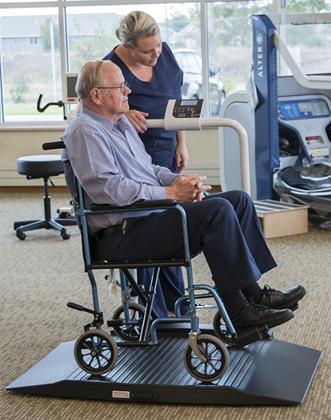


Every day in hospitals and clinics, staff face a dangerous choice. They either transfer a frail patient out of their wheelchair to get an accurate weight or skip the measurement altogether. Both options are bad. Difficult wheelchair transfers cause patient falls and staff injuries.
These heavy patient handling issues can lead to incorrect medication doses that follow a patient for weeks. If your facility faces a lack of safe weighing equipment, you are carrying a clinical risk that a proper patient wheelchair scale can eliminate today.
The right digital wheelchair scale lets patients stay seated, roll onto the platform, and get weighed safely in under two minutes. This guide walks you through how these scales work, what features matter, and how to pick the right one. You can also check our full range of medical weighing equipment to see what fits your facility.
Table of Contents
ToggleA specialized healthcare scale designed for wheelchairs is a low-profile platform scale. It is built for patients who cannot safely stand. The patient stays seated, rolls onto the platform, and the weight measurement system calculates the total weight (patient plus chair) through internal load cells. You subtract the chair weight using the tare function to get the actual weight.
Using a digital wheelchair scale for patient weighing simplifies the process. The display shows the reading and holds it steady even if the patient shifts slightly. On better models, this “hold” function locks the number automatically so staff can focus entirely on the patient.
Load cells are small sensors under the platform that convert physical force into an electrical signal. Most quality scales use four, one at each corner. If even one is damaged or dirty, your medical weight measurement becomes unreliable.
This is a major safety issue. To maintain a high-accuracy medical scale, regular calibration is vital. Good medical scale accuracy prevents medication dosing errors, which protects vulnerable patients.
The digital indicator shows the weight, allows tare, and on advanced units, stores readings. A good indicator has a large display readable from 1.5 metres away. This small detail prevents transcription errors at the point of care.
The right type depends on your space, patient volume, and how often the scale needs to move.
A roll-on scale sits flush with the floor or uses ramps on both ends. The patient rolls in from one side and exits the other, ideal for busy hospital corridors.
A portable scale moves easily between rooms. It typically has a folding ramp, built-in handles, and a detachable screen. It is the most practical wheelchair scale for clinics or home visits.
Fixed platform scales are bolted to the floor. They are built for heavy daily use and offer the most stability. The trade-off is zero flexibility, a poor choice for small or shared spaces.
A portable scale is not just about convenience. It is about whether staff actually use the scale at all. Clinics with only one fixed scale often show incomplete weight records. Staff naturally avoid the extra transport step, especially with complex patients. A portable scale that travels with staff removes that barrier.
Finding the best wheelchair medical scale means focusing on safety features rather than brand names.
Handrails give patients something to hold. Avoid unstable weighing platforms that wobble, as they turn a standard procedure into a high-risk patient weighing scenario.
Key safety features:
Standard scales handle up to 300 kg. Heavy-duty models reach 500 kg or beyond. Overloading damages load cells permanently, one of the most common causes of scale repair calls.
Standard wheelchairs are 65–70 cm wide. Bariatric chairs reach 80 cm or more. Your platform must fit your widest chair. Measure first to ensure safe patient weighing.
Portable scales drift. On a slightly uneven floor, readings can be off by 0.5–1.5 kg. For most patients, this is fine. For patients on weight-based chemotherapy or dialysis, it is not acceptable.
Calibration gets skipped. Most guides tell you to calibrate regularly. What they leave out is that many clinics skip it due to admin burden, and nobody notices until a clinical incident forces a review.
Handrails are not standard. Many mid-range models are sold without them. A patient who tips off a platform during weighing carries consequences that no scale spec sheet covers. Buy for your actual patient population, not the average case.
This wheelchair medical scale buying guide comparison table highlights the key differences to help you choose the right equipment.
| Feature | Portable Wheelchair Scale | Roll-On Wheelchair Scale | Fixed Hospital Scale |
| Mobility | High | Low | None |
| Weight Capacity | Up to 300 kg | Up to 500 kg | Up to 500 kg+ |
| Installation | None required | Ramps needed | Floor mounting |
| Best For | Clinics, home visits | Busy hospital wards | Bariatric units |
| Handrails | Optional | Optional | Usually included |
Choosing the right wheelchair scale is a clinical decision, not just a purchasing one. The wrong choice leads to inaccurate readings, staff injury, and gaps in records. The right choice removes all of that friction.
Three steps to take now. First, measure your widest wheelchair and match it to a platform with at least 10 cm clearance on each side. Second, decide between portable and fixed based on your actual patient flow. Third, schedule calibration before the scale arrives, not after something goes wrong.
Yes, when used correctly. They eliminate the fall risks associated with transferring frail patients. To ensure safety, always select a scale with a non-slip platform, sturdy handrails, and a low-angle ramp.
Look for a high weight capacity, a wide non-slip platform, and secure handrails. Additionally, ensure it has a digital indicator with a “hold” function and a tare option to easily subtract wheelchair weight.
Yes. They are essential tools in both settings. Hospitals benefit from heavy-duty, fixed roll-on scales, while clinics usually prefer highly versatile, portable models that can easily move between patient exam rooms.
It is a lightweight scale designed for easy transport. It features built-in wheels, carrying handles, folding ramps, and a battery power option, allowing clinical staff to weigh patients in various rooms.
A complete guide should cover platform dimensions, weight capacity limits, power options, and safety certifications. It must also compare portable versus fixed models to match the scale to your clinic’s specific workflow.
Sign up to receive updates, promotions, and sneak peaks of upcoming products. Plus 20% off your next order.